Sample chapter: 1.1 International business and international management: concepts, actors and the institutional environment
This chapter serves unit objective 1: defining international business and international management and identifying who acts in the international environment.
Every Slovak company of any size is already part of international business, whether it exports, imports components, banks with a foreign-owned bank or competes against foreign online shops. The question for managers is not whether the firm is international but how it manages the cross-border parts of its activity.
Two related concepts
The two concepts differ in perspective. International business looks at transactions and markets – what crosses borders, in which form and why. International management looks inside the firm – how a head office coordinates subsidiaries, how expatriates are selected, how a group controls currency risk. A multinational company (MNC), or multinational enterprise (MNE), is a firm that owns and controls value-adding activities in at least two countries; the defining feature is foreign direct investment with control, not mere exporting.
| Form | What crosses the border | Control and commitment | Example |
|---|---|---|---|
| Export and import | Goods or services | Low; no assets abroad | A Slovak furniture maker sells through an Austrian importer |
| Contractual modes | Know-how, brands, rights | Medium; contract-based | Licensing a patent, franchising a restaurant concept, management contracts |
| Portfolio investment | Capital without control (below 10 % of votes) | None over management | A pension fund buys shares of a German carmaker |
| Foreign direct investment | Capital with lasting interest and control (10 % or more of votes) | High; assets and people abroad | Kia builds and runs the plant near Žilina |
Table 1.1 — The main forms of international business. The 10 % threshold for direct investment follows the OECD Benchmark Definition and the IMF balance-of-payments manual; Unit 10 treats FDI in depth.
The actors
Firms are the core actors: large MNEs such as Volkswagen or Siemens, small and medium-sized enterprises (SMEs) that export, and born globals – young, often digital firms that sell in many countries from their first years (the Slovak antivirus company ESET is a frequently cited example of fast early internationalisation). Around them act three groups of institutions.
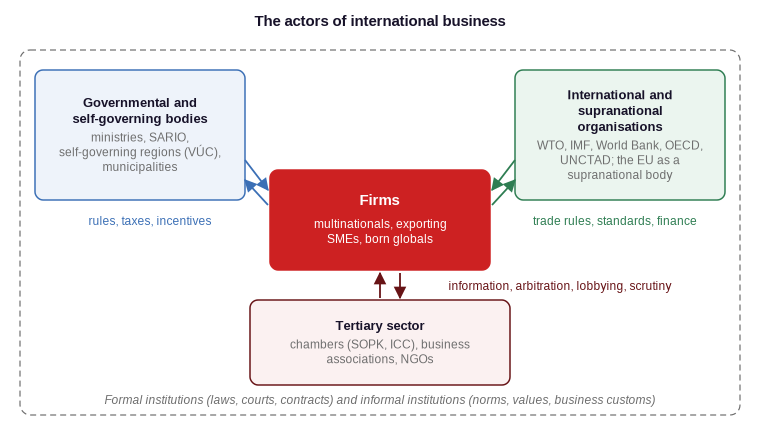
- Governmental and self-governing organisations. National governments set trade, tax, labour and investment rules; in Slovakia the Ministry of Economy, the Ministry of Foreign and European Affairs and the investment and trade development agency SARIO. Self-governing regions (VÚC, for example the Prešov Self-Governing Region) and municipalities zone land, build industrial parks and co-finance infrastructure for investors.
- International and supranational organisations. The WTO sets trade rules (Unit 2); the IMF and the World Bank deal with balance-of-payments stability and development finance; the OECD sets guidelines for multinational enterprises and tax standards; UNCTAD monitors investment. The European Union is supranational: its rules on the single market, trade policy and competition bind Slovak firms directly.
- The tertiary sector. Chambers of commerce (the Slovak Chamber of Commerce and Industry, SOPK), business and employer associations, the International Chamber of Commerce (ICC, author of the Incoterms rules), standard-setting bodies and non-profit organisations. They provide information, arbitration, certificates of origin and lobbying, and NGOs increasingly scrutinise MNEs on human rights and the environment.
The institutional environment
Douglass North described institutions as “the rules of the game”. Formal institutions are laws, regulations, courts and contracts; informal institutions are norms, values and business customs. A firm entering a country with weak contract enforcement or high corruption faces higher transaction costs even if formal laws look similar. That is why international managers read country risk ratings, World Bank governance indicators and the OECD's country reports, not only tariff schedules.
UNCTAD ranks multinationals by the transnationality index (TNI), the simple average of three ratios: foreign assets to total assets, foreign sales to total sales and foreign employment to total employment. A Slovak group reports: total assets €420 million, of which €126 million abroad; sales €380 million, of which €247 million abroad; 2,400 employees, of whom 480 abroad. Calculate its TNI and interpret it.
Show the solution
Approach.
- Foreign assets ratio: 126 / 420 = 0.30 (30 %).
- Foreign sales ratio: 247 / 380 = 0.65 (65 %).
- Foreign employment ratio: 480 / 2,400 = 0.20 (20 %).
- TNI = (30 + 65 + 20) / 3 = 38.3 %.
Result. The group is strongly export-oriented (65 % of sales abroad) but still produces mainly at home (30 % of assets, 20 % of staff abroad). It is an international exporter with a modest multinational footprint; its management challenges are foreign markets and currencies more than managing foreign plants.
- International business covers all cross-border transactions; international management covers how a firm plans, organises, leads and controls them.
- The MNE is defined by direct investment with control in at least two countries, not by exports.
- Firms act among governmental and self-governing bodies, international organisations and the tertiary sector of chambers, associations and NGOs.
- Formal and informal institutions shape the cost of doing business; the TNI summarises how far a firm's assets, sales and staff are abroad.
Check yourself — answer before you move on:
- A Slovak firm buys 6 % of the shares of a listed Polish company as a financial investment. Is this FDI?
Answer
No. Below the 10 % threshold and without a lasting management interest it is portfolio investment.
- Name one self-governing and one tertiary-sector organisation that a foreign investor in eastern Slovakia might deal with.
Answer
For example the Prešov or Košice Self-Governing Region (self-government) and the Slovak Chamber of Commerce and Industry or a regional business association (tertiary sector).
- Why can two countries with similar company laws differ greatly in the cost of doing business?
Answer
Because informal institutions and enforcement differ: corruption, the speed of courts and business customs change transaction costs even when formal rules are similar.