Sample chapter: 1.1 Why culture matters in management: basic concepts
This chapter serves unit objectives 1 and 2: what intercultural management is, why culture matters and which basic concepts the course uses.
Fifty years ago most managers of a Slovak sports club could spend a whole career working with people who had grown up within a few hundred kilometres of the stadium. Today a professional ice-hockey dressing room in Prešov may hold players from Slovakia, Czechia, Canada, the United States and Finland, a head coach who thinks in Finnish, a strength coach trained in Sweden and an agent negotiating from Toronto. Sponsors are multinational companies, broadcasters sell rights across borders and fans follow the club on platforms run from California. Managing such an organisation means managing across cultures every day.
Intercultural management is the part of management that deals with this reality. It does not replace the general functions you know from Management — planning, organising, leading and controlling — but it asks how each of them changes when the people involved bring different expectations about authority, time, rules, relationships and communication.
Why culture matters in management
Three observations explain why managers cannot ignore culture. First, people interpret the same behaviour differently. A Finnish coach who says little in a meeting may be listening carefully; a Slovak player may read the silence as disapproval. A Canadian player who praises a teammate loudly may mean exactly what he says; a Czech teammate may suspect exaggeration. Second, management practices are cultural products. Performance reviews, open-door policies, flat hierarchies and team meetings where juniors contradict seniors grew up in particular societies and do not transfer automatically. Third, organisations increasingly depend on cross-border cooperation: player transfers, international tournaments, sponsorship contracts with foreign brands and European funding all require people to agree across cultural lines.
Research supports these observations. In the largest early study of work values, Geert Hofstede analysed surveys of IBM employees in some fifty countries, collected around 1967–1973, and found systematic national differences in attitudes to authority, individualism, competition and uncertainty (published as Culture's Consequences, 1980). Later projects — Trompenaars' surveys of managers, the GLOBE study of 62 societies (2004) and many others — confirmed that national differences in work values exist, even though they explain only part of individual behaviour.
Basic concepts
A few concepts recur in every unit of this course. Values are broad preferences for one state of affairs over another — for example equality over hierarchy. Norms are shared rules of what is expected in a situation — for example arriving five minutes early for practice. Practices are the visible behaviours, symbols, rituals and heroes through which values and norms show themselves. A stereotype is a fixed, oversimplified belief that all members of a group share a trait; a generalisation is a statement about a tendency in a population that remains open to individual exceptions and to new evidence.
| Concept | Meaning | Example from a hockey club |
|---|---|---|
| Value | what people regard as desirable | loyalty to the team before personal statistics |
| Norm | expected behaviour in a situation | the captain speaks first after a lost game |
| Practice | visible behaviour, ritual, symbol | the player of the match wears the club's old helmet |
| Stereotype | rigid belief about all members of a group | “Canadians only want to fight” |
| Generalisation | tendency in a population, open to exceptions | “Finnish teams tend to value structured systems; check how this coach works” |
Table 1.1 — Five basic concepts and how they appear in a club.
Ethnocentrism is the tendency to judge other cultures by the standards of one's own and to regard one's own ways as natural or superior. The opposite stance, ethnorelativism, accepts that one's own culture is one way among many of organising life. Ethnorelativism is not the same as cultural relativism in the strong sense that “anything is right if a culture practises it”: a club can respect different communication styles and still insist that racist insults or bullying are never acceptable.
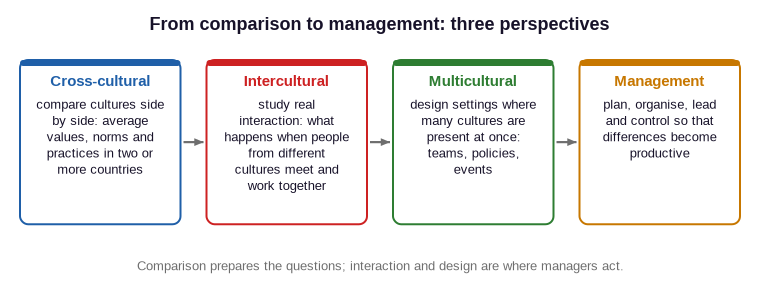
Three perspectives: cross-cultural, intercultural, multicultural
The literature uses three related words. Cross-cultural research compares cultures side by side — for example the average attitude to hierarchy in Slovakia and in Finland. Intercultural analysis studies what happens when people from different cultures actually interact — the Finnish coach and the Slovak players in the same video session. Multicultural describes a setting where several cultures are present at once, such as a dressing room with five nationalities. Managers need all three: comparison to anticipate differences, interaction to handle real encounters, and multicultural design to build teams and policies that work for everyone.
A further debate concerns the future. The convergence thesis holds that globalisation, English as a common language and global media make cultures more similar; the divergence thesis holds that deep values change slowly and that people may even emphasise their identity more strongly in a globalised world. Most researchers find a mixed picture: practices such as technology, dress and business jargon converge quickly, while values about authority, family and trust change slowly. For a manager this means that a player who speaks fluent English and uses the same apps may still hold very different expectations about how a coach should treat him.
The general manager of a club prepares the arrival of a Finnish assistant coach and writes three sentences in an internal memo: (a) “Finns never talk.” (b) “Research describes Finland as a culture where silence in conversation is comfortable and not a sign of disagreement; we should not over-interpret pauses.” (c) “He will certainly be honest because all Finns are honest.” Classify each sentence and rewrite the weak ones.
Show the solution
(a) is a stereotype: absolute (“never”), about all members, and not open to evidence. (b) is a useful generalisation: it refers to research, speaks of a tendency, and draws a managerial consequence. (c) is a positive stereotype — still a stereotype, and dangerous because it may stop the club from checking facts. Rewrite (a): “Finnish communication is often described as economical; we will ask him directly how he prefers to give feedback.” Rewrite (c): “We will apply our normal due diligence and references, as for any coach.”
Result. Generalisations are tools for preparing questions, not answers about a person.
- Intercultural management applies the management functions to situations where people from different cultures work together.
- Culture is shared and learned; it shows itself in values, norms and practices.
- Generalisations describe tendencies and remain open to evidence; stereotypes are rigid and apply a trait to everyone.
- Ethnorelativism respects other ways of life without accepting that anything goes.
- Cross-cultural comparison, intercultural interaction and multicultural design are three complementary perspectives.
Check yourself — answer before you move on:
- Why is the sentence “All Canadians are friendly” a problem even though it is positive?
Answer
It is a stereotype: it attributes a trait to every member of a group and closes the question instead of opening it. Positive stereotypes still lead to wrong expectations and to disappointment when a person does not match them.
- What is the difference between ethnorelativism and strong cultural relativism?
Answer
Ethnorelativism accepts that one's own culture is one way among many; strong cultural relativism claims that any practice is right if a culture accepts it. A manager can be ethnorelative and still enforce universal limits such as the ban on racist abuse.
- Give one example each of a cross-cultural and an intercultural question.
Answer
Cross-cultural: “Is power distance higher in Slovakia than in Finland?” Intercultural: “What happens in a video session when a Finnish coach asks Slovak players to criticise his tactics?”