Sample chapter: 1.1 What the financial system does
This chapter serves unit objective 1: explaining the five core functions of the financial system and why each matters for the real economy.
Every economy faces the same mismatch: the people who save are rarely the people with the best uses for savings. A household putting aside €200 a month has no factory to build; a firm with a profitable project may have an empty account. The financial system connects the two — and brings the money back to the saver with interest, dividends or capital gains as the price of the service.
Five functions, one purpose
Economists summarise the system's work in five functions. One bank performs all five every day, and they share one purpose: moving purchasing power to where it is most valuable.
| Function | What it does | Everyday example |
|---|---|---|
| Payments | Lets goods, services and assets change hands safely | Paying rent by transfer; tapping a card |
| Mobilising savings | Pools small amounts into sums that finance investment | Many deposits fund one factory loan |
| Allocating capital | Decides which projects get financed | A bank funds the stronger business plan |
| Sharing risk | Passes risk to those better able to bear it | Home insurance; a diversified fund |
| Producing information | Condenses judgements into prices and rates | A rising bond yield signals more risk |
Table 1.1 — The five functions of the financial system.
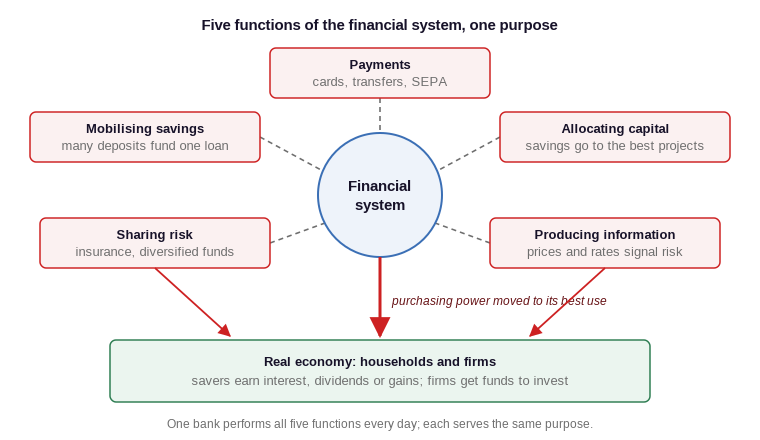
Payments and the mobilisation of savings
The payment function is the most visible. Cash, cards, credit transfers and direct debits allow millions of daily exchanges without barter. The Single Euro Payments Area (SEPA) lets a firm in Prešov pay a supplier in Lyon as easily as one in Košice. When payments fail, trade stops almost at once.
Mobilising savings means collecting many small sums into amounts that can finance real investment. No household can lend €1 million for a production line, but 4 000 depositors with €250 each can, through a bank — and each can still withdraw when needed, although the loan runs for years.
Allocating capital, sharing risk and producing information
Allocating capital is the system's most consequential job, because which projects receive scarce savings shapes future productivity. Banks screen loan applicants, investors compare returns and risks, and interest rates ration funds towards projects that can pay for them. Financing the wrong projects wastes savings as surely as leaving them idle.
Sharing risk does not make risk disappear; it moves risk to those who can carry it most cheaply. An insurer pools similar risks so the average loss becomes predictable; a fund spreads money across many companies. Producing information is a by-product of the rest: prices and interest rates summarise what millions of participants believe.
An insurer covers 1 000 flats in Prešov against water damage. Each flat has a 0.5% chance per year of a €30 000 loss, independently of the others. The insurer adds 20% to expected claims to cover its costs and profit. What premium does each household pay, and what has it gained?
Show the solution
Approach.
- Expected claims per year = 1 000 × 0.005 = 5; expected total = 5 × €30 000 = €150 000, i.e. €150 per flat (the actuarially fair premium).
- Add the 20% loading: €150 × 1.20 = €180 per flat per year.
- Each household swaps a small chance of a ruinous €30 000 loss for a certain €180.
Result. Each household pays €180 a year: €30 above expected loss buys protection from ruin — the essence of risk sharing.
Because finance runs on confidence and interconnection, it can also spread shocks: in the 2008 global financial crisis, bad mortgage loans made lenders doubt all borrowers, and healthy firms lost access to credit. For business, the price and availability of credit are set in the financial system, not in your business plan.
- The financial system moves purchasing power from surplus units to deficit units and back again.
- Its five functions are payments, mobilising savings, allocating capital, sharing risk and producing information.
- Capital allocation is the most consequential function for long-run growth.
- Risk sharing moves risk to those who bear it most cheaply; it never abolishes risk.
- Because the system rests on confidence, it can also spread shocks to healthy firms.
Check yourself — answer before you move on:
- Which function is at work when a pension fund spreads its money over 300 companies?
Answer
Sharing risk (diversification).
- Why is capital allocation the most consequential function?
Answer
Which projects receive scarce savings shapes the economy's future productivity.
- What is the actuarially fair premium if 2 000 cars each face a 1% chance of a €4 000 claim?
Answer
Expected claims = 2 000 × 0.01 × €4 000 = €80 000, i.e. €40 per car.